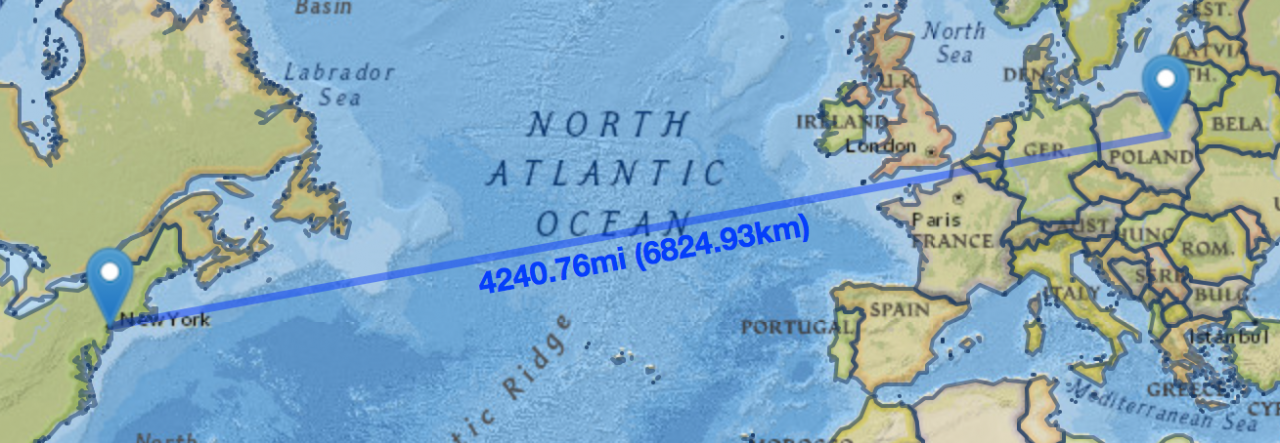
My Great-Grandparents
I chose to write my family migration blog about the ancestors on my dad’s side of the family. His parents were both Polish, and their parents migrated from Poland to the United States. This part of my heritage was easy for me to decide upon as aspects of Polish culture remain central in my family’s life today. Although both of my grandparents have recently passed away, I was able to find some information about their parent’s lives regarding their migrations from my father and his three siblings. The remainder of my findings were gathered from ancestry and family history search websites.
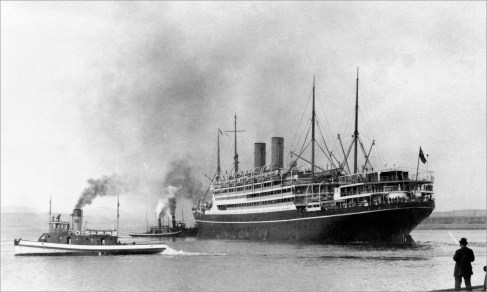
My grandfather’s father was named Roman Gregorek, and he was born in Warsaw, Poland. There are no details today as to what his life was like prior to migration; however, he left Warsaw when he was 18 years old. He was the first of his immediate family to migrate, leaving his father, Markus, behind in Warsaw. Roman traveled via a ship called Kaiserin Auguste Victoria out of Hamburg, Germany (The Statue of Liberty – Ellis Island N.d.). You can watch a more detailed video about the ship here. He arrived at Ellis Island on June 27th, 1913, where the record lists him as a laborer/mason (The Statue of Liberty – Ellis Island N.d.). He met and lived with his uncle, Ignaz Gregorek, who resided in Brooklyn, New York.
My grandfather’s mother was named Jennie Gregorek. She was also born in Warsaw, Poland and moved to New York in 1904 with her mother and siblings to meet their father who was already living in America (Family Search 2018).
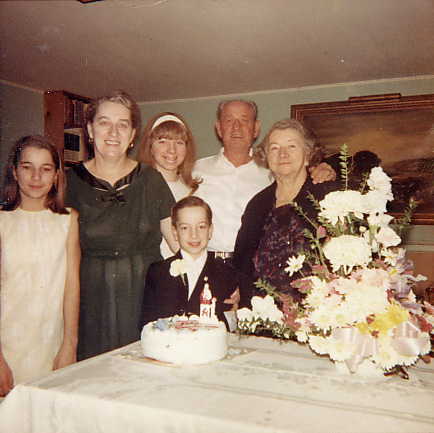
Jennie married Roman in 1916 in Kings County, Brooklyn, New York at the age of 16. They settled in Kings, Brooklyn, New York, where they had seven children and spent the rest of their lives.
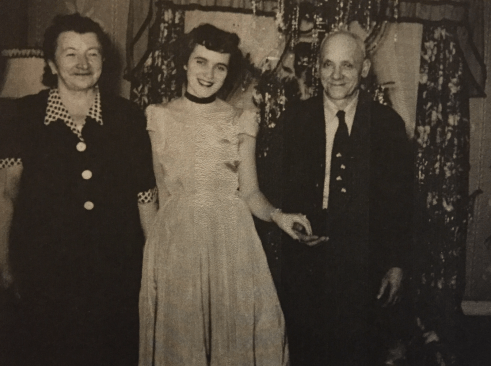
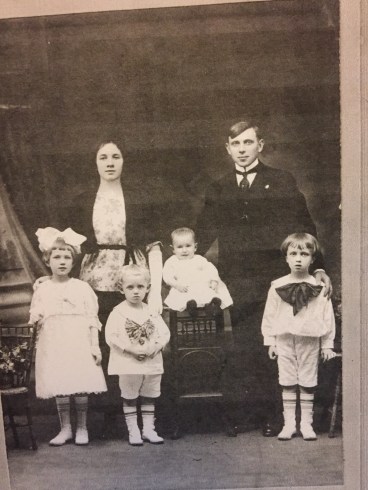
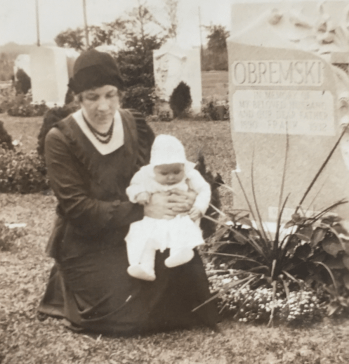
Little information about my grandmother’s parents could be found; however their names were Janina Zamojska and Frank Obremski. They were also from Poland and according to the 1920 census record, Frank may have migrated to the US in 1900 and Janina in 1910 (Family Search 2018). They married in 1912 in Kings County, New York. Our family knows that Frank was an engineer working for the Long Island Rail Road as he passed away in a train accident while Janina was pregnant with my grandmother! I will always remember my grandmother telling me how sad she was never being able to meet her father.
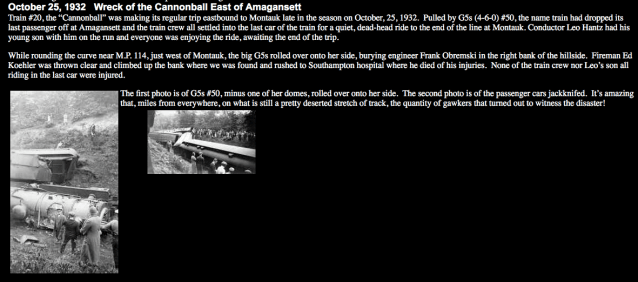
Part of a news article about my great-grandfather, Frank Obremski’s, train accident and death (Trains Are Fun N.d.)
How Do my Great-Grandparents Compare to the “Typical” Polish Migrant in the Early 1900s?
When looking at the broader context, I found that my relatives came to the United States during a time when many Poles were migrating. At the beginning of the 1900s, Poles were suffering oppression in Russian Poland due to oppressive legal legislation (Lucille 1951). Additionally, the land was becoming increasingly insufficient to support the growing population. The lack of industrial development and scarcity of available agricultural land fueled emigration before World War I (Wytrwal 1961). Therefore, many Poles left for a better income due to economic and land problems. Most pre-World War I immigrants were either single men or men whose families were abroad. The high percentage of single men who migrated alone makes their migration more individualistic. Men with families would only migrate if it was necessary due to prolonged unemployment (Fox 1922). These immigrants from Poland were typically landless peasants who went into unskilled labor or farming after migrating (Wytrwal 1961). Those who migrated prior to 1929 in the first wave of immigrants were known as “za chlebem,” or “for bread,” due to their poverty and lower-status (Berdes and Zych 2005:44). Dissatisfaction with the conditions in Poland attracted many Poles to American opportunities, equality, and hope, which contrasted against the poverty and hardships experienced in Poland (Wytrwal 1961). All of my great-grandparents migrated during this time of mass migration out of Poland. Additionally, Roman Gregorek migrated on his own, just like many single men did at the time. Although my family has no details as to why Roman decided to migrate, based on the typical Polish migrant at the time, he may have been seeking better opportunities and pay while escaping the harsh Russian rule. He was also listed as a laborer/mason on the Ellis Island record, further fitting the description of the “typical” lower-class Polish migrant.
The United States greatly attracted overseas migrants from 1900 until the start of World War I. Between 1897 and 1913, there were 2,000,000 Polish entrants into the United States (Greene 1961:47). During that time, the highest number of Poles coming to America in a single year was in 1913, the year my great-grandfather, Roman, migrated (Pula 1995:19). In fact, over 80% of the Polish movement to the New World came in 1913 (Greene 1961:46). By 1920, two-thirds of Poles living outside Poland lived in the United States (Greene 1961:47). When entering, Ellis Island became the principal inspection point for newcomers, as millions of migrants passed through, including my relatives (Wytrwal 1961). In 1910, New York was the second most populated state with Poles, tied with Illinois with 475,000, and behind Pennsylvania with 500,000 (Fox 1922:62). These states were idea for many Polish immigrants as they were prime for industrial development and had favorable agricultural conditions. Over three-quarters of newly arrived immigrants have spent the entire period of their residence in the United States where they have lived since their arrival (Fox 1922:63). The places in which they settled were not only beneficial for them economically, but Poles tended to live together in specific segregated areas of cities, such as Buffalo, New York. A 1910 report showed that the Poles living there had their own churches, businesses, and stores (Pula 1995:23). Buffalo has been said to have been an important Polish center as early as 1880 (Wytrwal 1961). Therefore, when my great-grandparents migrated to America, they settled with other Polish immigrants in Brooklyn, another apparent popular settling point for many due to the formation of their own community. Just as the majority of Polish immigrants have remained living where they first landed after migration, my great-grandparents lived in Kings County, Brooklyn, New York for the remainder of their lives. In fact, after my grandparents got married, they also remained in New York until their deaths, just one hour away from where they were born and raised in Brooklyn. Although not knowing much about my great-grandparents and their migration history before this research, it is evident that they closely represent the “typical” migrants from Poland to America in the early 1900s.
US Policies at the Time of My Family’s Migration
My great-grandparents all migrated to the United States between 1900 and 1913. At this time, there was little federal regulation of immigration into America. The vast majority who arrived at the port were allowed to enter. In fact, the immigration service excluded only 1% of the 25 million immigrants from Europe who arrived between 1880 and World War I (American Immigration Council 2016). Many immigrants at the time were inspected at Ellis Island, some getting a health examination, and then allowed through. Prior to 1900, the 1882 Chinese Exclusion Act restricted Chinese workers from immigration and other laws restricted people from other Asian countries (American Immigration Council 2016). The 1921 and 1924 Quota Laws established limits based on race and nationality, disfavoring Central and Eastern Europeans (American Immigration Council 2016). Read more about the more recently created immigration laws here. However, my ancestors arrived before the quotas were put into place, facing no excluding policies as White European immigrants at their time of arrival.
Theories of Migration
When reading about the typical migrants at the time of my relatives’ migrations, I thought of the New Economics of Labor Migration Theory. This theory represents a household or family decision, as opposed to the isolated individual’s decision (Massey, Durand, and Malone 2003). It considers relationships in order to establish financial security and protect families. This diversification strategy helps to overcome failed economic systems due to a lack of insurance found in a single labor market. Therefore, in this theory, some family or household members will migrate to the United States for higher wages in order to build savings. Other members will find employment other places in their home country, while some remain working at home. This helps to reduce the risk of one economic system failing and not having any other income to rely upon. With this theory, there will likely be some support if one system fails (Massey et al. 2003). With regards to Polish immigration, it was mentioned that most pre-World War I immigrants were either single men or men whose families remained in their home country. Men with families would only migrate if they were forced to due to prolonged unemployment, going into unskilled labor or farming after migrating (Fox 1922). This demonstrates that a diversification in labor markets is common and beneficial for families who are struggling in one area, using migration as an insurance policy and type of welfare. Roman’s wife, Jennie, migrated with her mother and siblings to meet their father who was already in the United States. Therefore, their father must have migrated on his own during the early 1900s to likely make a better living for their family. However, this demonstrates the disadvantage of family separation that comes with the New Economics of Labor Migration Theory. Not only does this theory explain or indicate the physical separation of families that occurs, but it also assumes that all of the members are in agreement on whether or not migration should occur and who should migrate. Although specific details about my relatives are uncertain, decisions like these could not have been easy for them or the rest of the migrant population.
Not all who migrated from Poland to America were men with families they left behind. Single men also made up a significant portion of the Polish migrant population. Neoclassical economics describes everyone as a rational individual who makes decisions based on the weighing of costs and benefits (Massey et al. 2003). With regards to migration, if the benefits were to outweigh the costs, an individual would migrate. Although assuming that everyone is a rational individual when making decisions, the weighing of costs and benefits is something frequently done in everyday life. In the case of my family, Roman Gregorek was the first to migrate, coming to America alone. As Roman was a single young man, the decision must have been easier for himself, as opposed to if he had a family of his own. The drawback of this theory is that it infers everyone always makes rational decisions. When in reality, decision-making can be much more complex when considering additional factors, such as the needs of family members.
The Segmented Labor Market Theory additionally fits with Polish migration motives in the early 1900s. This theory looks at the receiving societies and their “pull factors,” as opposed to the push factors in sending countries (Massey et al. 2003). The economic structure of developed and industrial countries, such as the United States, requires a demand for labor. Immigrants who come to the United States satisfy low-wage, bottom-level jobs for the purpose of income, as opposed to status or prestige. These wages cannot be raised in order to maintain consistency within the job hierarchy (Massey et al. 2003). The Poles who migrated to America in the early 1900s filled jobs in industries such as iron and steel making, coal mining, and construction (Wytrwal 1961). Roman was listed as a laborer/mason when he arrived, seemingly entering into a similar working class job. These jobs and wages were evidently a main reason many Poles migrated to America, highlighting the effects of America’s pull factors and need for hard workers.
Although I have been discussing migration trends during the time period in which my family migrated, migration has been continuing ever since. The Cumulative Causation Theory explains why people continue to migrate (Massey et al. 2003). After one person or group migrates, networks are formed for others who follow. This social capital helps to take away the fear of the unknown by knowing familiar people in an unfamiliar place. It can additionally help to reduce emotional, psychological, or financial costs due to close ties and support (Massey et al. 2003). If an individual or family already knows of someone who has migrated before them, this could, therefore, increase the likelihood of their migration. Many Polish immigrants migrating at the time of my relatives lived in segregated communities with one another, such as in Brooklyn. Migrating to areas where Polish immigrants have already settled must have made new migrants more comfortable, joining with previously migrated Poles in America. When Roman migrated, he lived with his uncle in Brooklyn. He knew that his uncle was living in America, thus giving him a place to stay and a relationship to rely on. The decision to migrate with a relative already abroad must have made the decision easier and slightly less daunting.
At the time of my great-grandparents’ migrations, the World Systems Theory was a cause for migration from Poland to America. In this theory, large firms in developed nations will enter into developing nations in search of land or materials (Massey et al. 2003). The developing communities will often be stripped of their raw materials and land, disrupting their economies. Roads and infrastructure are built by the developing nation. This, in turn, fuels migration, paving the path for people to leave. As cultural messages are displayed through development, tourism, and the media, this typically sparks a desire for those in developing nations to migrate to where their goods are being sent (Massey et al. 2003). In the early 1900s, Poland was not being colonized by America, which is where the majority of its migrants were traveling. However, they were migrating for the hope of better land, work opportunities, income, and a desire to escape the oppressive Russian legislation. Russia was acting as the developed nation entering into Poland and causing political and economic disruptions, fueling Polish migration to America under the World Systems Theory.
 Jamie's Family Migration Blog