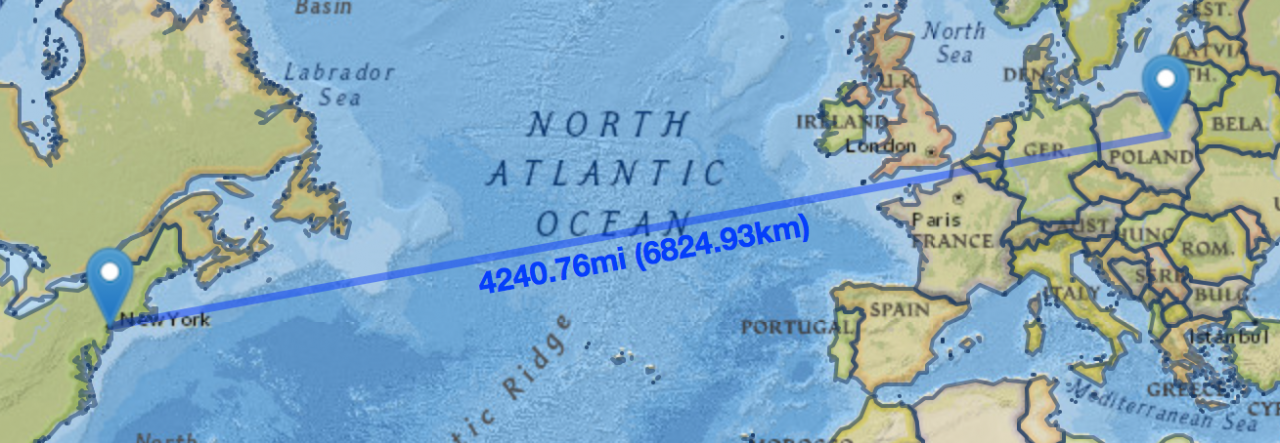
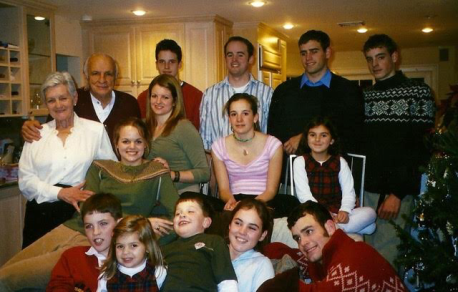
Prior to writing these blogs, the extent of my knowledge regarding my family’s migration story and the history of Polish migration was extremely limited. I knew that my great-grandparents migrated to America from Poland; however, the reasons and circumstances under which they migrated were unknown to me. Although both of my grandparents passed away last year, these blog assignments have allowed me to feel closer to them, as I learned more about their history and their experiences as children of first-generation migrants. One thing I forgot to mention in my earlier blog posts is that we did not actually call my grandparents “grandma” and “grandpa.” In fact, we called them “babci” and “dziadzi,” the Polish names for grandma and grandpa. This is an additional demonstration of a way in which our Polish culture, although more symbolic in recent generations, is still expressed today.
One major thing I learned about my ancestors and the Polish ethnic group was that my relatives came to the United States during a time in which many Poles were migrating. Not only did my relatives migrate at a time when many Polish migrants were coming to America, but they also resided in New York, which was the second most populated state containing Poles in 1910 (Fox 1922:62). Just as the majority of Polish immigrants have remained living where they first landed after migration, my great-grandparents lived in Kings County, Brooklyn, New York for the remainder of their lives. In fact, after my grandparents got married, they also remained in New York until their deaths, just one hour away from where they were born and raised in Brooklyn. I always knew that my grandparents moved to Long Island after they were married, which is where my father and his siblings were born and raised. However, I never understood the significance of it’s location in proximity to Brooklyn until now, especially after discussing the movement to suburbia in my previous blog post.
My research has highlighted the importance of the contexts of reception and exit when looking at previous waves of migration as well as contemporary migration. When Roman migrated to the United States as a laborer, similar to other White European migrants at the time, it was likely easy for him to find employment, especially within his co-ethnic community. However, when thinking about contexts of reception in contemporary migration, migrants may face greater struggles. Mylan and Shenk’s (2003) documentary Lost Boys of Sudan demonstrates the complications and struggles that impact immigrants’ abilities to “make it” in America in recent decades. Language ability was a factor for the Lost Boys as they only spoke very basic and incomplete English when they arrived in America. They did not live in a co-ethnic community where they could integrate their native language with English; rather, they had to take ESL classes right away. Race was also seen to be a major factor in the Lost Boys’ transition into American society, as Santino reported feeling shamed about the darkness of his skin. He claimed that he could not even compare himself to the Black people in America, as he was too Black and looked odd compared to everyone around him. As a result of their need to work to gain money for themselves and for their friends back home, the boys found it hard to fit in time for school because they worked so much. Their main desire was to go to school and get an education; however, their lower social class and need to work caused the education goals for many of them to be put on the back burner (Mylan and Shenk 2003). The struggles that the Lost Boys faced once arriving due to their language ability, lack of occupational skills, lack of education, and race demonstrate the contexts of exit that many people face when coming to America today. As Poles are White Europeans who often migrate into co-ethnic communities, the hardships that the Lost Boys faced were likely less prevalent among my relatives.
When I read Eva’s blog, her family’s migration story seemed similar to mine. Our relatives migrated around the same years in the early 1900s as unskilled workers and farmers coming from Central Europe. While many aspects of our ancestors’ experiences sounded the same, she claimed that her relatives were of darker skin, potentially harming their acceptance and rapid integration into society, more similarly related to the Lost Boys than my relatives. Although all Central European migrants at the start of the 20th century are often said to have similar stories and experiences, this is an example of how even immigrants migrating from Central Europe at the same time can differ in their contexts of exit and reception. She also stated that her ancestors struggled to find jobs and housing when they initially got to America. This further highlights the importance of co-ethnic communities and how depending on where they settle, Central European immigrants can face different struggles.
When my relatives arrived in America between 1900 and 1913, there was little federal regulation on immigration into America. Many immigrants were inspected at Ellis Island and allowed through after a health examination. My relatives were not Chinese, unaffected by the 1882 Chinese Exclusion Act. They also came before the 1921 and 1924 Quota Laws, facing no excluding policies as White Europeans, and entering into America legally (American Immigration Council 2016). Therefore, illegality did not play a role in any negative contexts of reception my relatives, or any Poles, received in the early 20th century. However, if my relatives were Chinese, they would have been prohibited from entering the United States in the early 1900s. Polish migrants coming at different times will also vary in their experiences based on immigration laws at the time. For my family, their story could have looked differently if they were coming just 10 years later with the implementation of quota laws that disfavored Central and Eastern Europeans (American Immigration Council 2016).
In Caroline’s blog post, she discussed her abuela’s migration in 1985 to Puerto Rico. She decided to migrate to Puerto Rico because it allowed her the easiest access into the United States. She migrated via yola, which is a small and unsafe boat carrying eighteen people. It took two days for her to arrive by yola to Puerto Rico. They left a night to avoid being seen by any authority figures, such as the police. It was very cold, and no one got any food or sleep on the journey. Many people also dealt with dizziness and vomiting. Her daughters were left behind with other family members. This was very hard for her abuela as well as her abuela’s daughters because they could not image a life without each other. They begged and cried as they watched their mother get on the yola to create better opportunities for her daughters. This story demonstrates the different migration experiences that migrants face depending on the time and country of origin. Caroline’s abuela’s journey was evidently more difficult and dangerous, compared to the journey of my relatives, as she was traveling as an undocumented immigrant. As we have learned in class, undocumented immigrants face the fear of being caught and detained or deported beck to their country of origin, which is why her journey embarked in the dark of night.
My relatives’ reasons for migrating were most likely for increased labor and agricultural opportunities. However, the reasons at the start of the 20th Century differ from those arriving later, such as those who were fleeing communist rule. Although the Poles fleeing communist rule are often not communist themselves, they are still not well received in the United States. In recent years, Donald Trump has claimed that an applicant cannot become a citizen if he or she is a member of the Communist party or if he of she has been within the past 10 years (Puglise 2016). These restrictions that have developed since my relatives migrated to the United States would have been barriers regarding their safe and legal entry. More about Communist entry into the United States can be read about here. This further shows how the contexts of exit and reception can differ over the years and impact the ability to assimilate.
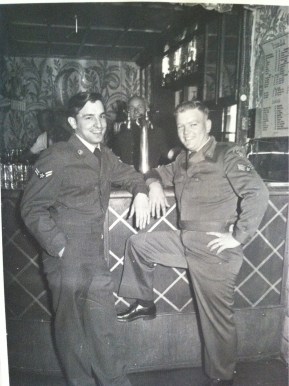
The arrival of immigrants into places where a community of their compatriots already exists helps to cushion the impact of foreign culture and provide assistance (Portes and Rumbaut 2001). When migrating in the early 1900s, many Poles tended to settle together in specific segregated areas of cities in America, such as Kings, Brooklyn. Therefore, living in Brooklyn with other Poles who spoke Polish was beneficial to keep aspects of Polish culture, while also learning new American customs. Churches and religious groups are powerful places that unite community members. As many Poles migrated as Roman Catholics, having their own Polish Roman Catholic churches likely provided additional comfort and community while in Kings, Brooklyn. While reading Karisneyca’s blog, I was surprised to find that when her mother migrated to the United States in the 1990s, she also settled in an area of Brooklyn. Although she migrated roughly 80 years after my great-grandparents, it was interesting to find that Brooklyn remains to have many co-ethnic areas within it. Her new community consisted of a majority of Panamanians who migrated after the Invasion of Panama. Her mother was able to connect with other people in Brooklyn in a community that felt like home. Within that community, they were able to speak Spanish and English, eat traditional foods, and participate in the annual Panamanian parade. Therefore, Karisneyca, her mother, and their family are still in touch with their Latinx identity through language, traditions, and customs. The establishment of other ethnic members already residing in the community is helpful for an easier transition through the support of networks, as opposed to migrating to a new community where no other immigrants lived. Otherwise, there would be a struggle to integrate themselves into an American culture, similar to the Lost Boys, speaking no English. They would have also likely lost their native cultures quicker if they were living in a community that did not embrace any aspects of their traditional cultures. Consonant acculturation describes the learning of a new culture and abandonment of the home language and culture simultaneously across generations (Portes and Rumbaut 2001). Living in an area that does not promote biculturalism, as opposed to the co-ethnic communities of Brooklyn, would warrant a more rapid abandonment of native culture, potentially describing consonant acculturation as a pattern of assimilation.
Writing these blog posts was extremely important in not only allowing me to learn about my family’s history, but also in understanding the evolution of immigration policies. We have learned many examples of the extreme vetting processes in place today to become a legal citizen. Donald Trump’s wall is also physically preventing migrants form crossing the border, causing them to face even more dangerous routes of entry. However, due to factors such as the time of my relatives’ migrations, their country of origin, and their race, entering into the United States legally was far from as difficult as it is for many migrants today. Therefore, learning what immigration policies were like at the time of my relatives’ migration has allowed me to further understand the vast changes that have been made since then and the repercussions of the extreme enforcement policies prevalent in today’s society.
 Jamie's Family Migration Blog